Essential Components for a Residential Solar Power System: A Complete Homeowner’s Guide
Introduction
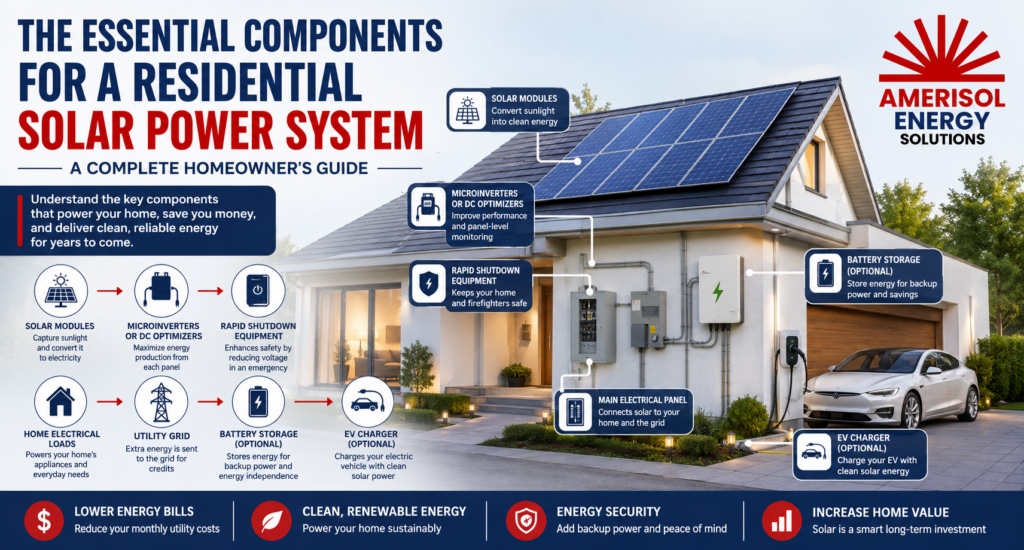
If you’re comparing residential solar quotes, you’ve probably noticed that no two proposals look exactly the same. One installer recommends microinverters, another suggests a string inverter with optimizers, and a third includes battery storage while others don’t. With so many options, it can be difficult to know which components are truly essential and which are optional upgrades.
Understanding the essential components of a residential solar power system is one of the best ways to make an informed decision. The quality of each component affects your system’s efficiency, reliability, safety, maintenance requirements, and long-term return on investment.
In this guide, we’ll explain every major component found in a modern grid-tied residential solar system, discuss optional upgrades such as battery storage and EV charging, explain how systems are sized, and highlight common mistakes homeowners should avoid before signing a contract.
How Does a Residential Solar Power System Work?
A residential solar power system converts sunlight into electricity that powers your home. During the day, solar panels generate direct current (DC) electricity, which is converted into alternating current (AC) electricity by an inverter. The electricity is then used by your home’s appliances, with excess energy either exported to the utility grid or stored in a battery, depending on your system design.
Typical System Flow
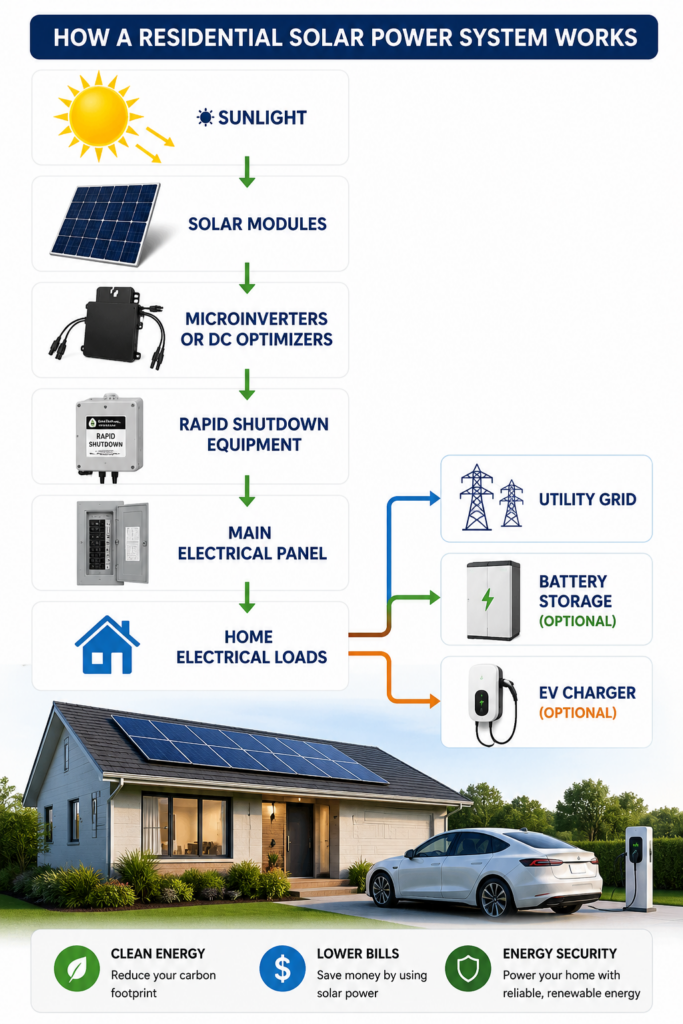
Each component plays an important role in the performance and safety of your solar investment.1. Solar Modules (Solar Panels)
Solar modules are the heart of every residential solar power system. They capture sunlight and convert it into electricity.
Today’s homeowners typically choose high-efficiency monocrystalline panels because they generate more electricity using less roof space.
What to Look For
- High efficiency ratings
- Strong product warranty (typically 25 years)
- Performance warranty
- Low annual degradation rate
- Excellent manufacturer reputation
Higher-quality modules generally produce more energy over their lifetime and may continue operating efficiently for 30 years or more.
2. Solar Racking System
The racking system securely attaches the solar panels to your roof.
Although often overlooked, the racking system is one of the most important structural components of the installation.
A quality racking system should:
- Resist corrosion
- Withstand high wind and snow loads
- Protect roof integrity
- Provide proper ventilation beneath the panels
Proper flashing and roof attachments are equally important to prevent leaks throughout the life of the system.
3. Inverters: Microinverters vs. String Inverters
Solar panels produce DC electricity, but your home uses AC electricity. The inverter performs this conversion.
There are two primary inverter technologies used in residential solar systems.
| Feature | Microinverters | String Inverter |
|---|---|---|
| Installed on each panel | Yes | No |
| Shade performance | Excellent | Good |
| Panel-level monitoring | Yes | Usually with optimizers |
| Expansion | Easy | More limited |
| Upfront cost | Higher | Lower |
Microinverters
Microinverters are installed beneath each solar panel. Every panel operates independently, making them ideal for roofs with multiple orientations or partial shading.
Benefits include:
- Better energy production in shaded conditions
- Panel-level monitoring
- Improved reliability
- Easier future expansion
String Inverters
A string inverter connects multiple panels together into one electrical circuit.
Advantages include:
- Lower upfront cost
- Simpler installation
- Excellent performance on unshaded roofs
Both technologies are excellent choices when properly matched to the home’s design.
4. DC Power Optimizers
Power optimizers are electronic devices installed on individual panels while still using a central string inverter.
They help reduce power losses caused by:
- Tree shading
- Dirt accumulation
- Different roof angles
- Mismatched panel performance
Optimizers combine many of the monitoring benefits of microinverters while maintaining the efficiency of a central inverter system.
5. Rapid Shutdown Equipment
Rapid shutdown devices are required by modern electrical codes for most residential solar installations.
Their purpose is simple:
If emergency responders need to access the roof during an emergency, rapid shutdown equipment quickly reduces voltage on rooftop conductors, improving firefighter safety.
Although homeowners rarely think about this component, it is one of the most important safety features in a solar installation.
6. Battery Storage
Battery storage has become one of the fastest-growing segments of the residential solar market.
While batteries are increasingly popular, they should be viewed as an essential consideration for homeowners who want backup power, energy independence, or protection from utility outages.
Benefits include:
- Backup power during outages
- Reduced dependence on the utility grid
- Increased self-consumption of solar energy
- Potential savings under time-of-use utility rates
Many homeowners install batteries at the same time as their solar system, while others choose battery-ready equipment that allows storage to be added later.
7. Main Electrical Panel
Every solar system connects to your home’s main electrical panel.
Depending on your home’s age and electrical capacity, a panel upgrade may be necessary before solar can be installed.
A qualified installer will evaluate:
- Available breaker space
- Service size
- Electrical code compliance
- Future expansion needs
Planning for future additions such as batteries or EV chargers during the initial installation can reduce upgrade costs later.
8. Solar Monitoring System
Modern residential solar systems include online monitoring that allows homeowners to track energy production from a smartphone or computer.
Monitoring systems typically display:
- Daily production
- Monthly production
- Lifetime production
- Environmental benefits
- System alerts
- Equipment status
Panel-level monitoring can also help identify underperforming modules quickly.
9. EV Charger Integration
If you currently own—or plan to purchase—an electric vehicle, integrating an EV charger with your solar system can significantly increase your energy savings.
Charging an EV using solar energy can reduce transportation costs while maximizing the value of your solar investment.
Planning for EV charging during the initial system design often makes installation easier and less expensive.
Optional Upgrades
Many homeowners choose to enhance their systems with additional features.
Popular upgrades include:
- Whole-home battery backup
- Smart electrical panels
- Generator integration
- Advanced energy monitoring
- Critter guards
- Snow guards
- Additional battery capacity
Although optional, these upgrades can improve convenience, resilience, and long-term flexibility.
How to Size a Residential Solar Power System
Every home has unique energy needs, so there is no one-size-fits-all solar system.
A professional system design considers several factors, including:
- Average monthly electric bill
- Annual electricity usage (kWh)
- Available roof space
- Roof orientation
- Roof pitch
- Shading
- Local climate
- Future electric vehicle charging
- Heat pumps
- Pool equipment
- Hot tubs
- Future energy needs
The goal is to design a system that provides excellent long-term performance while fitting your home’s available roof area and energy consumption.
Typical Number of Solar Panels
Although every home is different, typical residential systems include:
| System Size | Approximate Number of Panels* |
|---|---|
| 6 kW | 14–16 |
| 8 kW | 18–20 |
| 10 kW | 23–26 |
| 12 kW | 28–32 |
*Based on modern residential solar modules in the 400–450 W range.
Typical Lifespan of Solar Components
| Component | Expected Lifespan |
|---|---|
| Solar modules | 25–30+ years |
| Microinverters | 20–25 years |
| String inverter | 10–15 years |
| Battery storage | 10–15 years |
| Racking system | 25+ years |
| EV charger | 10–15 years |
Proper installation and regular maintenance help maximize equipment life.
The Residential Solar Installation Process
Most installations follow these steps:
- Initial consultation
- Energy usage review
- Site assessment
- System design
- Proposal review
- Permitting
- Utility interconnection approval
- Equipment installation
- Electrical inspection
- Permission to Operate (PTO)
The exact timeline varies depending on permitting requirements and local utility processes.
Common Mistakes Homeowners Make
Before signing a contract, avoid these common pitfalls:
- Choosing the lowest price without comparing equipment quality.
- Ignoring product and workmanship warranties.
- Failing to evaluate the condition of the roof.
- Not planning for future battery storage.
- Overlooking EV charging needs.
- Selecting equipment without panel-level monitoring when shading is present.
- Comparing system prices instead of projected lifetime energy production.
- Not reviewing estimated annual energy generation.
- Assuming all solar equipment is the same.
- Working with companies that do not clearly explain their equipment recommendations.
A lower-priced proposal may not always provide the best long-term value.
Solar Quote Comparison Checklist
When reviewing proposals, compare more than just the final price.
✔ Solar module manufacturer
✔ Module efficiency
✔ Product warranty
✔ Performance warranty
✔ Inverter type
✔ Rapid shutdown equipment
✔ Battery compatibility
✔ EV charging readiness
✔ Monitoring capabilities
✔ Racking system
✔ Workmanship warranty
✔ Estimated annual production
✔ Project timeline
✔ Utility interconnection support
✔ Future expansion options
Frequently Asked Questions
Can I install solar without batteries?
Yes. Most residential solar systems are grid-tied and operate without battery storage.
Can I add batteries later?
In many cases, yes. Choosing battery-compatible equipment today can simplify future upgrades.
Do solar panels work during a power outage?
Standard grid-tied systems automatically shut down during an outage for safety. Battery systems with backup capabilities can continue powering selected circuits or, in some cases, the entire home.
Which is better: microinverters or a string inverter?
It depends on your roof design, shading conditions, budget, and future expansion plans. Both technologies are widely used and can perform exceptionally well when matched to the right application.
How many solar panels does my home need?
The number depends on your electricity usage, available roof space, local climate, and the wattage of the panels selected. A professional design will determine the ideal system size.
How long do residential solar panels last?
Most high-quality solar modules are designed to operate efficiently for 25 to 30 years or longer.
Will solar increase my home’s value?
Many studies suggest that owned solar systems can increase property value, though results vary by market and other factors.
Can solar power an electric vehicle?
Yes. Many homeowners use rooftop solar to offset a significant portion of their EV charging costs.
How AmeriSol Energy Solutions Can Help
Choosing the right residential solar equipment goes beyond selecting solar panels. The combination of modules, inverters, racking, battery storage, and monitoring equipment can significantly impact your system’s long-term performance and value.
At AmeriSol Energy Solutions, we help homeowners compare equipment options with confidence. Whether you’re reviewing multiple installer proposals or planning a new system, our team can provide guidance on selecting high-quality components that match your home’s needs and future energy goals.
We can help you evaluate and source:
- Solar modules
- Commercial inverters
- Battery Energy Storage Systems (BESS)
- EV charging infrastructure
- Balance-of-system equipment
If you’re comparing quotes and would like an independent review of the equipment being proposed, we invite you to request a free consultation through our website. Our goal is to help you make an informed decision with confidence.
Final Thoughts
A residential solar power system is much more than a collection of solar panels. Every component—from the racking system and inverter to the battery and monitoring platform—plays an important role in the system’s safety, efficiency, and long-term reliability.
Understanding these essential components will help you compare proposals more effectively, ask the right questions, and choose a system designed to meet your energy needs for decades to come. By focusing on equipment quality, proper system sizing, and future-ready design, you’ll be well positioned to maximize the value of your solar investment while enjoying clean, renewable energy for years to come.
References
- U.S. Department of Energy (DOE) – Homeowner’s Guide to Going Solar https://www.energy.gov/eere/solar/homeowners-guide-going-solar
- Solar Energy Industries Association (SEIA) – Residential Solar Energy https://www.seia.org/initiatives/residential-solar
- National Renewable Energy Laboratory (NREL) – Solar Research https://www.nrel.gov/solar
- NREL – Best Practices in Photovoltaic System Operations and Maintenance https://www.nrel.gov/docs/fy18osti/68631.pdf
- U.S. Environmental Protection Agency (EPA) – Green Power Partnership https://www.epa.gov/green-power-markets
- EnergySage – Residential Solar Buyer’s Guide https://www.energysageom/solar
- National Fire Protection Association (NFPA) – National Electrical Code (NEC) https://www.nfpa.org/nec
- U.S. Department of Energy – Solar Photovoltaic Technology Basics https://www.energy.gov/eere/solar/solar-photovoltaic-technology-basics
- Lawrence Berkeley National Laboratory – Selling Into the Sun: Price Premium Analysis of Homes with Solar https://emp.lbl.gov/publications/selling-sun-price-premium-analysis
- Energy Star – Home Electrification Resources https://www.energystar.gov