DC-Coupled BESS Retrofits for Community Solar: Can Battery Storage Recover Clipped Energy?
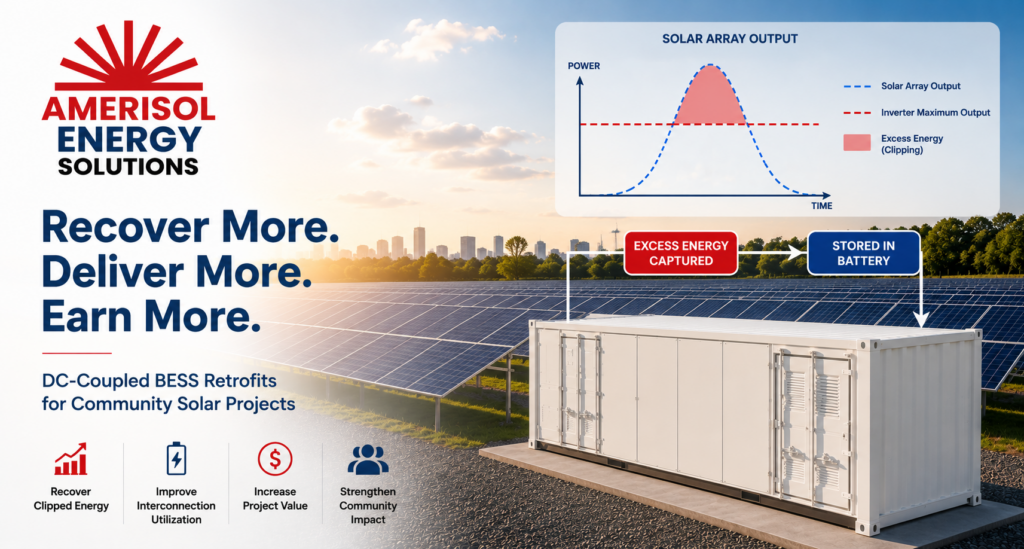
As many community solar projects mature, owners are looking beyond simply generating electricity—they’re looking for ways to generate more value from existing assets.
One opportunity receiving increased attention is retrofitting Battery Energy Storage Systems (BESS) to existing solar installations. Specifically, DC-coupled battery retrofits have the potential to recover energy that would otherwise be lost to inverter clipping while improving utilization of existing interconnection capacity.
While not every project is a good candidate, the right system can significantly improve overall project economics without expanding the site’s AC export capacity.
In this article, we’ll explain how DC-coupled BESS retrofits work, their advantages, their challenges, and how to determine whether a community solar project may benefit from this approach.
What Is Solar Clipping?
Solar modules produce DC electricity, which is converted into AC power by the inverter.
Many commercial and community solar systems intentionally install more DC solar capacity than the inverter’s AC rating. This is known as the DC-to-AC ratio.
For example:
- 6 MWDC solar array
- 5 MWAC inverter capacity
During most of the year, this configuration improves inverter utilization because solar modules rarely operate at their full nameplate rating.
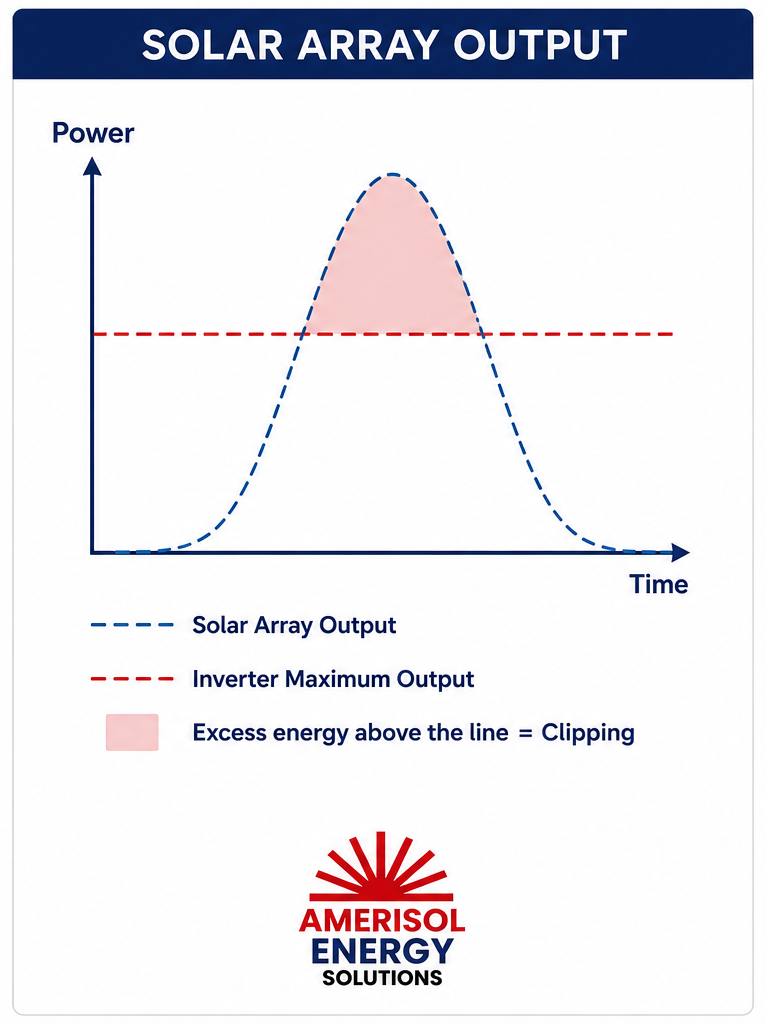
However, during cool, sunny days—or during periods of exceptionally high irradiance—the solar array may produce more power than the inverter can convert.
Once the inverter reaches its maximum output, the excess energy is simply clipped.
Instead of generating additional electricity, that energy is lost.
Solar Clipping Illustration
How a DC-Coupled Battery Can Recover Clipped Energy
A DC-coupled battery connects on the DC side of the solar inverter.
Rather than allowing excess solar production to be clipped, the battery stores that energy and discharges it later when solar production decreases.
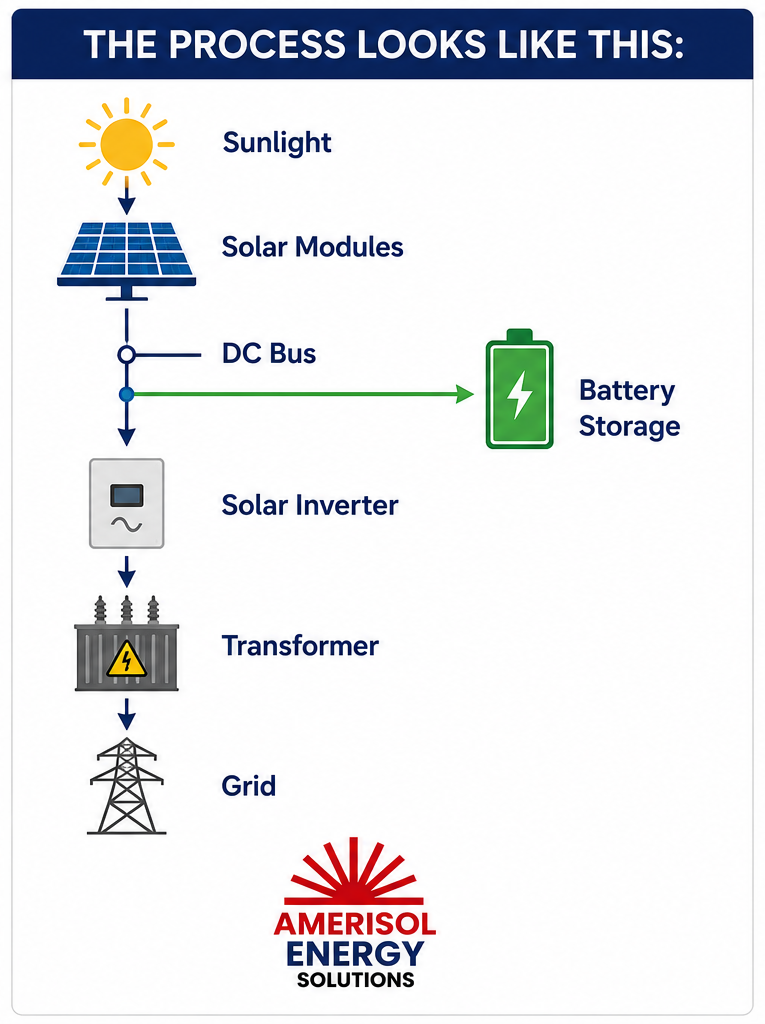
During periods when solar production exceeds inverter capacity:
- Excess energy charges the battery.
- The inverter continues exporting at its maximum rating.
- Once solar production declines, the battery discharges through the inverter.
- More solar energy ultimately reaches the grid instead of being wasted.
This allows the project to make better use of the existing interconnection while increasing total energy delivered over the course of the day.
Why Community Solar Projects Are Good Candidates
Many community solar projects share characteristics that make clipping recovery attractive.
These projects often feature:
- Higher DC-to-AC ratios
- Fixed interconnection limits
- Large, unobstructed arrays
- Long remaining operating lives
- Predictable production profiles
- Professional operations and maintenance programs
Because expanding an interconnection can be expensive—or even impossible in many utility territories—recovering energy within the existing export limit can provide meaningful value.
Benefits of DC-Coupled BESS Retrofits
Recover Energy That Would Otherwise Be Lost
The primary advantage is capturing energy that would normally be clipped.
Rather than wasting peak solar production, that energy is stored and delivered later.
Maximize Existing Interconnection Capacity
Utilities increasingly limit new interconnection capacity.
Instead of increasing export capability, DC-coupled storage allows owners to better utilize the interconnection they already have.
Improve Revenue Potential
Depending on the project’s compensation structure, battery storage can:
- Shift production into higher-value hours
- Improve hourly market revenues
- Reduce curtailment losses
- Support participation in utility or ISO programs (where available)
Recovering clipped energy alone rarely justifies a battery investment, but combining several revenue streams can significantly improve project economics.
Increase Asset Value
Battery storage can extend the usefulness of existing solar assets by improving operational flexibility and increasing long-term revenue potential.
For owners planning to hold projects for many years, this can improve overall return on investment.
Is Every Community Solar Project a Good Candidate?
No.
Some projects experience very little clipping.
Others may have inverter architectures that make DC retrofits difficult or expensive.
Before considering a retrofit, developers should evaluate:
- Historical production data
- Actual clipping losses
- Existing inverter technology
- Remaining project life
- Interconnection limitations
- Electricity pricing structure
- Available incentives
- Battery installation costs
A detailed engineering study is essential before selecting a storage solution.
Technical Challenges of Retrofitting DC-Coupled Storage
Unlike a new hybrid solar-plus-storage project, adding DC-coupled storage to an existing facility often requires significant engineering.
Potential modifications may include:
- DC collection system upgrades
- New DC-DC converters
- Protection equipment
- Plant controller updates
- Communications integration
- Utility approvals
- Revised electrical studies
- Equipment compatibility verification
Some existing solar inverters are designed only for photovoltaic generation and may require replacement or additional equipment to support battery integration.
For certain projects, an AC-coupled battery system may prove more practical despite lower clipping recovery potential.
DC-Coupled vs. AC-Coupled Retrofits
| Feature | DC-Coupled | AC-Coupled |
|---|---|---|
| Recover clipped energy | ✅ Yes | ❌ No |
| Uses existing inverter more effectively | ✅ Yes | Limited |
| Retrofit complexity | Higher | Lower |
| New AC equipment required | Less | More |
| Best for new installations | Excellent | Good |
| Best retrofit option | Depends on existing system | Often easier |
The optimal architecture depends on the project’s existing equipment, operating objectives, and financial analysis.
What Makes a Strong Retrofit Candidate?
Projects are often good candidates when they have:
- Significant annual clipping losses
- DC-to-AC ratios greater than approximately 1.25
- Available space for battery installation
- More than 10 years of remaining project life
- Limited ability to increase interconnection capacity
- Time-of-use or hourly energy pricing
- Frequent inverter saturation during peak production
The most successful projects begin with detailed operational data rather than assumptions.
The Importance of Production Data
Battery sizing should never rely on nameplate capacity alone.
Instead, engineers should analyze:
- 5-minute or 15-minute inverter data
- Seasonal production profiles
- Clipping duration
- Peak clipping power
- Export limitations
- Historical irradiance
- Battery cycling opportunities
This information allows designers to optimize both battery power (MW) and energy capacity (MWh) while maximizing return on investment.
Future Outlook
As battery prices continue to decline and utilities place greater emphasis on grid flexibility, DC-coupled retrofits are expected to become increasingly attractive for existing community solar projects.
Owners who already have valuable interconnection capacity may find that improving the performance of existing assets is more economical than developing entirely new projects.
For the right site, battery storage can transform previously lost solar production into additional revenue while enhancing overall system flexibility.
Final Thoughts
DC-coupled BESS retrofits are not a one-size-fits-all solution, but they represent an exciting opportunity for many community solar owners seeking to maximize the value of their existing assets. By recovering clipped energy, optimizing interconnection utilization, and enabling more flexible energy delivery, these systems can improve both operational performance and long-term project economics.
The key to success is a detailed engineering and financial evaluation. Every project has unique production characteristics, equipment configurations, and revenue opportunities. A comprehensive feasibility study can determine whether a DC-coupled or AC-coupled battery solution offers the best return on investment.
At AmeriSol Energy Solutions, we help developers, EPCs, and asset owners evaluate solar and energy storage technologies for commercial and utility-scale projects. Whether you’re considering a new BESS installation or exploring a retrofit for an existing community solar project, our team can help identify the most effective solution based on your technical and financial objectives. Book your free consultation now!
Frequently Asked Questions
What is solar clipping?
Solar clipping occurs when a solar array produces more DC power than the inverter can convert into AC electricity, causing the excess energy to be lost.
Can a battery recover clipped solar energy?
Yes. A properly designed DC-coupled battery system can store excess DC energy before it is clipped and discharge it later when inverter capacity becomes available.
Is a DC-coupled retrofit better than an AC-coupled retrofit?
Not always. DC-coupled systems can recover clipped energy but are generally more complex to retrofit. AC-coupled systems are often easier to install on existing projects but cannot recover energy that has already been clipped by the PV inverter.
What information is needed to evaluate a retrofit?
The most important inputs include inverter production data, system one-line diagrams, equipment specifications, interconnection limits, utility tariff information, and historical operating data.
References
- National Renewable Energy Laboratory (NREL) – Evaluating Utility-Scale PV-Battery Hybrids in an Operational Model
https://research-hub.nrel.gov/en/publications/evaluating-utility-scale-pv-battery-hybrids-in-an-operational-mod/ - Fluence – AC-Coupled vs. DC-Coupled Solar + Storage
https://blog.fluenceenergy.com/energy-storage-ac-dc-coupled-solar - U.S. Department of Energy – Solar Energy Technologies Office
https://www.energy.gov/eere/solar - National Renewable Energy Laboratory – PV and Energy Storage Research
https://www.nrel.gov/grid/energy-storage.html - Sandia National Laboratories – Energy Storage Research
https://www.sandia.gov/ess-ssl/