Section 232 Polysilicon Decision Expected in August: What It Could Mean for Solar Projects
The U.S. solar industry is once again waiting on a major trade policy decision.
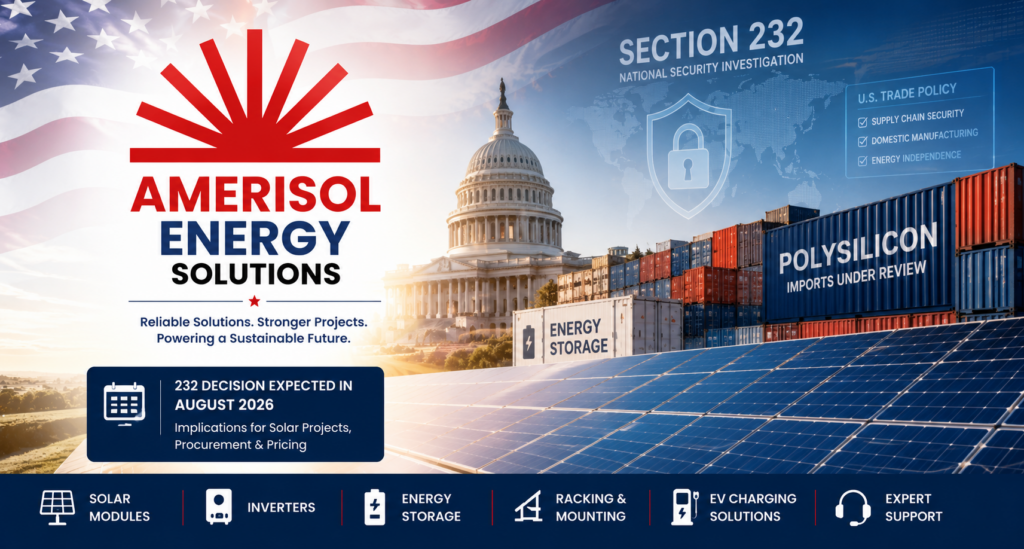
The White House is expected to issue its Section 232 proclamation regarding imported polysilicon in August 2026, following a delay from the originally anticipated June timeline. While the decision has not yet been finalized, many developers, EPCs, manufacturers, and distributors are already evaluating how it could impact project costs, procurement strategies, and domestic manufacturing.
Here’s what we know so far—and what it could mean for your next solar project.
What Is Being Investigated?
Unlike previous solar trade actions that focused on finished modules or cells, this investigation centers on polysilicon, the primary raw material used to manufacture solar cells.
The investigation is being conducted under Section 232 of the Trade Expansion Act of 1962, which allows the federal government to restrict imports that are deemed to threaten national security.
Why Was the Decision Delayed?
Many industry participants expected an announcement by late June.
However, according to industry analysis cited by Roth Capital Partners, the Department of Commerce submitted its report in mid-May, giving the White House a 90-day statutory period to respond. As a result, the expected decision has shifted into early August rather than June.
Why Polysilicon Matters
Every crystalline silicon solar module starts with polysilicon.
Although U.S. manufacturing capacity continues to expand, much of the global polysilicon supply still comes from overseas. Western wafer and solar cell manufacturers also depend on reliable supplies of non-Chinese polysilicon to meet domestic manufacturing and sourcing requirements.
Any new trade measures affecting polysilicon could influence the cost of:
- Solar cells
- Solar modules
- Utility-scale projects
- Commercial rooftop systems
- Manufacturing investments
Potential Impact on Module Prices
One reason the industry is watching closely is the potential impact on module pricing.
Roth Capital Partners estimates that if an import-only Minimum Import Price (MIP) is implemented, module pricing could increase by approximately $0.10 per watt.
In a more aggressive scenario that combines a minimum import price with additional ad valorem tariffs, module pricing could approach $0.49/W.
For a typical 100 MW solar project, even a $0.10/W increase would represent roughly $10 million in additional module costs.
Developers Are Already Adjusting
The uncertainty itself is affecting the market.
According to Roth Capital Partners, some large independent power producers have delayed module procurement for several months while waiting for greater policy clarity. At the same time, developers are increasingly adding change-in-law clauses to power purchase agreements to help manage potential cost increases if new trade measures are implemented.
Connection to the 45X Manufacturing Tax Credit
The delayed Section 232 decision comes as another major policy item—the proposed extension of the 45X Advanced Manufacturing Production Credit—has also been pushed back.
The 45X credit supports U.S. manufacturers producing solar modules, cells, wafers, backsheets, and battery components. According to Roth Capital Partners, draft legislation extending the credit is now expected after the midterm elections rather than this summer.
Together, these two policy decisions will play an important role in shaping the future economics of U.S. solar manufacturing.
What Should Developers Do Today?
Although no final decision has been announced, project teams can take practical steps to reduce risk:
- Review procurement schedules.
- Secure pricing where appropriate.
- Evaluate alternative manufacturers and sourcing options.
- Build contingency allowances into project budgets.
- Stay informed as policy developments unfold.
Projects entering procurement over the next several weeks should pay particularly close attention to any official announcements.
How AmeriSol Energy Solutions Can Help
Navigating today’s solar market requires more than simply finding the lowest equipment price. Trade policy changes, evolving domestic manufacturing incentives, FEOC requirements, and shifting supply chains can all affect project costs, procurement timelines, and equipment availability.
At AmeriSol Energy Solutions, we help developers, EPCs, installers, and commercial customers stay ahead of these changes by providing:
- Access to a broad network of trusted manufacturers for solar modules, inverters, battery energy storage systems (BESS), racking, EV charging equipment, and balance-of-system components.
- Multiple sourcing options to help reduce the risk of supply chain disruptions or unexpected pricing changes.
- Up-to-date market intelligence on Section 232 actions, FEOC requirements, domestic content programs, Safe Harbor deadlines, and other policy developments that may impact procurement decisions.
- Competitive pricing and logistics support through our nationwide distribution network.
- Technical guidance to help customers identify equipment alternatives that meet project specifications, budget requirements, and delivery schedules.
- Responsive customer service from initial equipment selection through project delivery.
Whether you’re planning a commercial rooftop installation, a community solar project, a utility-scale solar farm, or a battery energy storage system, our team can help you develop a procurement strategy that minimizes risk and keeps your project moving forward.
If you’re concerned about how upcoming Section 232 decisions could affect your project, contact AmeriSol Energy Solutions today. We’ll help you evaluate your equipment options, secure competitive pricing, and identify the best sourcing strategy for your project before market conditions change.
For immediate assistance:
Website: www.american-solar.com
Phone: (929) 376-0807
Email: contact@american-solar.com
Final Thoughts
The expected August Section 232 decision on polysilicon could become one of the most significant solar trade developments of 2026. While the final outcome remains uncertain, the industry is already adjusting procurement strategies, revising project assumptions, and preparing for potential pricing changes.
At AmeriSol Energy Solutions, we closely monitor changes in trade policy and the solar supply chain to help our customers make informed purchasing decisions. Whether you’re sourcing modules, inverters, or battery energy storage systems, staying ahead of policy changes can help minimize risk and keep projects on schedule.
References
- PV Magazine USA – U.S. polysilicon 232 decision delayed to August while 45X extension draft pushes past midterms, says Roth Capital Partners
https://pv-magazine-usa.com/2026/06/22/u-s-polysilicon-232-decision-delayed-to-august-while-45x-extension-draft-pushes-past-midterms-says-roth-capital-partners/ - U.S. Department of Commerce – Bureau of Industry and Security
Section 232 Investigations Overview
https://www.bis.gov/about-bis/bis-offices/office-strategic-industries-and-economic-security/section-232-investigations - Trade Expansion Act of 1962 (Section 232)
Cornell Law School Legal Information Institute
https://www.law.cornell.edu/uscode/text/19/1862 - Congressional Research Service
Section 232 Investigations: Overview and Issues for Congress
https://crsreports.congress.gov/product/pdf/IF/IF10667
- U.S. Department of Energy – Solar Energy Technologies Office
https://www.energy.gov/eere/solar - Solar Energy Industries Association (SEIA)
U.S. Solar Market Insight and Manufacturing Resources
https://www.seia.org/
- IRS – Advanced Manufacturing Production Credit (Section 45X)
https://www.irs.gov/credits-deductions/businesses/advanced-manufacturing-production-credit - U.S. Department of Treasury – Inflation Reduction Act Guidance
https://home.treasury.gov/policy-issues/inflation-reduction-act