Top 5 Expert Tactics to Delay-Proof Your Solar Projects and Avoid C&I Permitting Gridlocks
Why this matters
According to the SEIA Solar Market Insight Report, the US installed about 50 GW of new solar in 2024, with commercial and industrial (C&I) solar projects growing roughly 8 percent year-over-year. Yet thousands of megawatts still sit idle because of one culprit: a slow or stalled approval process. Roughly 20 000 permitting jurisdictions and 3 000 utilities each apply their own rulebook, so a single missing detail can push COD back by weeks. Here’s the playbook we use to keep projects moving.
The National Renewable Energy Laboratory (NREL) found that inconsistent permitting processes across thousands of jurisdictions are one of the leading causes of delays in U.S. solar deployment.
With record growth, avoiding project delays is more important than ever. Learn more about the 2024 solar boom.
1. Treat Permitting as an Engineering Discipline
Permitting is not a clerical checkbox. It is a technical review of structural, electrical, and fire-safety decisions. Jurisdictional quirks prove the point:
- New York City requires extra rooftop setbacks and custom conduit labels.
- Los Angeles adds a separate standby inspection run by the fire department, outside the LADBS flow.
- Arizona has pockets where construction cannot begin until interconnection is stamped “Approved,” and drawing sheets must follow utility formatting exactly.
These are engineering challenges, not paperwork hurdles. Staff or partner accordingly.
2. Know What Your AHJ Cares About
Most authorities having jurisdiction (AHJs) worry about five things:
- Safety – Clear firefighter pathways, labeled disconnects, safe working distances.
- Code Compliance – NEC alignment and local amendments on everything from conductor sizing to roof loads.
- Clarity – Can reviewers understand the design in minutes, not hours?
- Professional Accountability – PE stamp plus contact info for fast follow-ups.
- Community Impact – Noise, glare, sightlines, storm-water run-off.
Permitting reviewers aren’t looking to stall projects, but they need confidence that a system is safe, compliant, and appropriately documented.
“AHJs want to know that your system is safe and built to code, but most importantly, they want to see that the PE takes responsibility for it.”
AHJ priorities are rooted in public safety codes and NFPA/NEC standards. NREL’s SolarApp+ fire safety guidelines provide insight into what inspectors look for during permitting.
AHJ priorities are rooted in public safety codes and NFPA/NEC standards. NREL’s SolarApp+ fire safety guidelines provide insight into what inspectors look for during permitting.
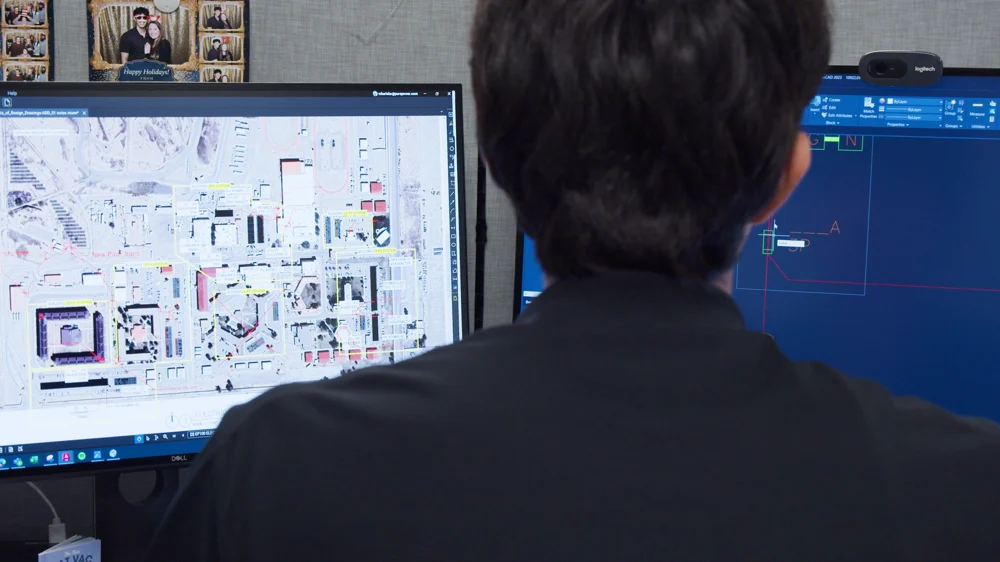
The layout is then returned to the racking vendor, who uses it to generate structural requirements for the pile plans. Pile plans inform civil engineering work, such as hydrology (H&H) and stormwater pollution prevention and pollution prevention plans (SWPPP) studies, which ultimately shape the full site design. Each step needs verification from the other disciplines to ensure feasibility.
For more on misconceptions that can stall progress, see our solar + storage myth-busting guide.

3. Build a Permit Package That Lands First-Pass Approval
A complete, code-aligned permit package is the fastest way to secure approval for C&I solar projects.
- Scaled site plan with array footprint, fire setbacks, and property lines
- Glare study near airports, roadways, or neighbors
- Structural letter confirming roof or pile capacity
- One-line diagram with conductor sizes, protection devices, and equipment IDs
- Trench and conduit routing for ground mounts
- Fire-code summary referencing IFC or local amendments
- Zoning confirmation, including lighting, ADA paths, and landscaping if required
- Floodplain note with FEMA map ID when applicable
- Environmental memo if state or federal triggers apply
- Manufacturer data sheets for every major component
- PE stamp and jurisdiction-specific notes (sheet size, north arrow, scale, index)
4. Nail Interconnection on the First Try
Align your interconnection design with utility standards from day one to avoid redesigns.
The Interstate Renewable Energy Council (IREC) provides a detailed overview of utility interconnection requirements and common pitfalls in distributed generation projects.
- Ask what transformer configuration and grounding the utility expects
- Confirm acceptable relay logic and point-of-common-coupling hardware
- Verify metering cabinet specs before procurement
- Make a 15-minute call with the utility engineer to clarify diagrams early

5. Five Fast Rules for Developers & EPCs
Follow these proven best practices to cut weeks off your C&I solar timeline.
- Engage engineering early – feasibility and code checks start before 30 percent design
- Map every stakeholder – AHJ, utility, fire marshal, historical board, airport authority
- Customize every drawing set – boilerplate packages invite rejection
- Maintain relationships – reviewers move faster when they trust your work
- Follow up smartly – 48-hour receipt check, mid-SLA status call, escalate with data not emotion
Permitting and interconnection will either defend or destroy your project schedule. Treat them as critical engineering phases and resource them like structural calcs or energy modeling. AmeriSol Energy Solutions (formerly American Solar Distributors) Partners have guided over 50 MW of projects through approval without a single redesign order.
Need backup on your next portfolio? Email sales@a86.d39.myftpupload.com or call +1 800 341 3927. Let’s keep your array generating, not waiting.