How to Choose the Right Commercial Solar Inverter: A Complete Guide for Business Owners and Developers
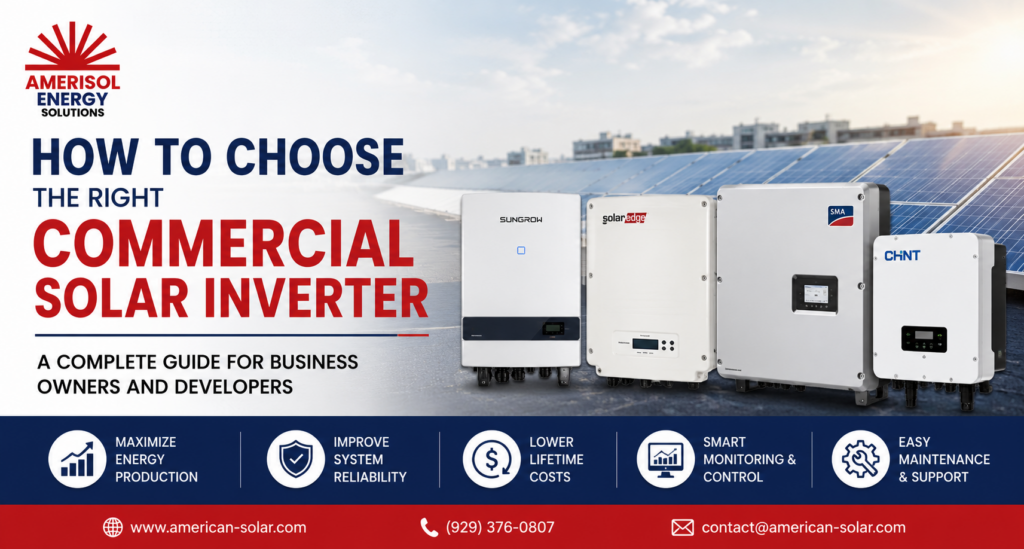
When people think about a commercial solar energy system, solar panels usually receive the most attention. However, the solar inverter is often considered the “brain” of the system. It converts the electricity generated by solar modules into usable AC power while continuously optimizing performance, monitoring production, and protecting the system.
Selecting the right inverter can significantly impact energy production, maintenance costs, system reliability, and the overall return on investment over the next 20–30 years.
Whether you’re developing a warehouse, manufacturing facility, office building, school, or utility-scale installation, understanding your inverter options will help you make an informed decision.
What Does a Commercial Solar Inverter Do?
A commercial solar inverter performs several critical functions:
- Converts DC electricity from solar modules into AC electricity for building use.
- Maximizes energy harvest using Maximum Power Point Tracking (MPPT).
- Synchronizes with the utility grid.
- Provides system monitoring and diagnostics.
- Detects electrical faults.
- Supports rapid shutdown requirements where applicable.
- Manages battery integration on hybrid systems.
- Communicates with energy management platforms.
Without an inverter, solar modules cannot supply usable electricity to your building or the electrical grid.
Types of Commercial Solar Inverters
String Inverters
Today, string inverters dominate most commercial rooftop projects.


Each string inverter connects to multiple strings of solar modules.
Advantages
- Lower installation costs
- High efficiency (typically 98–99%)
- Modular design
- Easy replacement
- Excellent monitoring capabilities
- Flexible system expansion
- Ideal for rooftops with multiple orientations
Best Applications
- Commercial rooftops
- Schools
- Warehouses
- Retail centers
- Manufacturing facilities
- Agricultural buildings
Central Inverters
Central inverters combine power from many solar strings into one large inverter.


Advantages
- Lower cost per watt on very large systems
- Fewer pieces of equipment
- Simplified utility-scale installations
Best Applications
- Utility-scale solar farms
- Large ground-mounted arrays
- Multi-megawatt projects
String Inverters vs. Central Inverters
| Feature | String Inverter | Central Inverter |
|---|---|---|
| Typical Project Size | 50 kW–5 MW | 1 MW+ |
| Installation Flexibility | Excellent | Limited |
| Redundancy | High | Lower |
| Maintenance | Easier | More complex |
| Monitoring | String-level | System-level |
| Expansion | Easy | More difficult |
| Rooftop Projects | Excellent | Rare |
| Utility Projects | Good | Excellent |
For most commercial buildings, string inverters are the preferred choice because they offer greater flexibility, easier maintenance, and better fault isolation.
Key Factors to Consider
1. System Size
The first consideration is the total DC capacity of your solar array.
Examples:
- 100 kW office building
- 300 kW warehouse
- 750 kW manufacturing plant
- 2 MW distribution center
Larger systems often use multiple commercial string inverters instead of a single large inverter to improve redundancy and simplify maintenance.
2. Number of MPPTs
Maximum Power Point Trackers (MPPTs) allow different strings to operate independently.
More MPPTs are beneficial when:
- Roof sections face different directions
- Partial shading exists
- Equipment is installed on multiple roof elevations
- Multiple module types are used
Projects with complex roof layouts benefit significantly from additional MPPT inputs.
3. Inverter Efficiency
Modern commercial inverters typically achieve efficiencies between 98% and 99%.
Although efficiency differences may appear small, even a 0.5% improvement can produce meaningful additional energy over the life of a large commercial installation.
4. DC-to-AC Ratio
Commercial systems are commonly designed with a DC-to-AC ratio between 1.1 and 1.4, depending on:
- Climate
- Module orientation
- Utility requirements
- Desired energy production
- Curtailment tolerance
Proper inverter sizing maximizes annual energy yield without excessive clipping.
5. Monitoring Capabilities
A quality inverter should provide:
- Real-time production
- Historical performance
- Fault notifications
- Remote diagnostics
- Fleet management
- Mobile monitoring
- Energy reports
Good monitoring helps detect issues early, reducing downtime and maintenance costs.
6. Battery Compatibility
Many businesses are adding battery energy storage systems (BESS) to reduce demand charges, improve resilience, or provide backup power.
If future battery integration is a possibility, consider an inverter platform that supports:
- Hybrid configurations
- Energy management systems
- Demand response
- Backup operation
- Microgrid applications
Planning ahead can reduce future upgrade costs.
7. Warranty and Service
Commercial solar inverters generally include warranties ranging from 10 to 15 years, with extended coverage available from many manufacturers.
When comparing products, evaluate:
- Warranty duration
- Local technical support
- Replacement turnaround
- Service network
- Spare parts availability
- Software update policies
Strong post-installation support is just as important as the equipment itself.
Additional Features Worth Considering
Depending on your project, you may also benefit from:
- Arc fault detection
- Ground fault protection
- Rapid shutdown compatibility
- Integrated disconnects
- AFCI protection
- Reactive power control
- Volt/VAR support
- Grid support functions
- Cybersecurity features
- Weather-resistant enclosures (NEMA 4X or IP66, where appropriate)
These capabilities can improve safety, simplify installation, and help meet utility or code requirements.
Common Mistakes to Avoid
Avoid these frequent specification errors:
- Selecting the lowest-cost inverter without considering long-term reliability
- Ignoring local service availability
- Oversizing or undersizing the inverter
- Choosing too few MPPT inputs for complex roof layouts
- Forgetting future battery integration
- Overlooking monitoring and communications features
- Failing to verify utility interconnection requirements
- Not considering replacement lead times
Choosing the right inverter is about balancing performance, reliability, and lifecycle costs—not just upfront price.
Recommended Commercial Inverter Categories
The best inverter depends on your project size and design goals. In general:
- Small commercial systems (50–150 kW): Compact three-phase string inverters with multiple MPPTs and advanced monitoring.
- Medium commercial systems (150–750 kW): Multiple high-power string inverters for flexibility, redundancy, and simplified maintenance.
- Large commercial and industrial systems (750 kW–5 MW): High-capacity string inverters or central inverters, depending on the site layout, utility requirements, and maintenance strategy.
At AmeriSol Energy Solutions, we regularly support projects using equipment from leading manufacturers such as Sungrow, SolarEdge, CPS, SMA, Chint, Solis, and others, helping customers select the best fit based on technical requirements rather than a one-size-fits-all approach.
How AmeriSol Energy Solutions Can Help
Choosing the right inverter involves more than matching power ratings. Our team can help evaluate:
- System size and electrical design
- Module compatibility
- MPPT configuration
- Battery readiness
- Utility interconnection requirements
- Budget and lifecycle cost considerations
- Equipment availability and lead times
Whether you’re designing a new commercial solar project or upgrading an existing installation, we can help source reliable, high-performance equipment from trusted manufacturers.
Need help selecting the right commercial inverter? Request pricing and availability through our website or schedule a free consultation to discuss your project’s technical requirements and procurement options.
Frequently Asked Questions
Which type of inverter is best for commercial buildings?
For most commercial rooftops, string inverters offer the best balance of flexibility, efficiency, redundancy, and ease of maintenance. Central inverters are generally better suited to very large, utility-scale installations.
How long do commercial solar inverters last?
Most commercial solar inverters have an expected service life of 10–20 years, depending on operating conditions and maintenance. Many systems will require at least one inverter replacement during the lifespan of the solar array.
Can commercial solar inverters work with battery storage?
Yes. Many modern inverter platforms support battery integration directly or can be paired with compatible battery inverters and energy management systems, making future expansion easier.
What size inverter does my commercial solar system need?
The ideal inverter size depends on the system’s DC capacity, desired DC-to-AC ratio, module configuration, utility requirements, and site-specific design considerations. A qualified solar engineer can determine the optimal sizing for your project.
Final Thoughts
A commercial solar inverter is one of the most important investments in any photovoltaic system. While solar modules generate the electricity, the inverter determines how efficiently that energy is converted, monitored, and delivered to your facility. By considering factors such as system size, MPPT configuration, efficiency, battery compatibility, monitoring capabilities, and long-term service support, you can select an inverter that maximizes performance and minimizes operational risk for years to come.
Partnering with an experienced equipment supplier and engineering team early in the design process can help ensure your project uses the right inverter for both today’s requirements and tomorrow’s energy goals.