Is Your Commercial Roof Ready for Solar? A Complete Roof Readiness Checklist
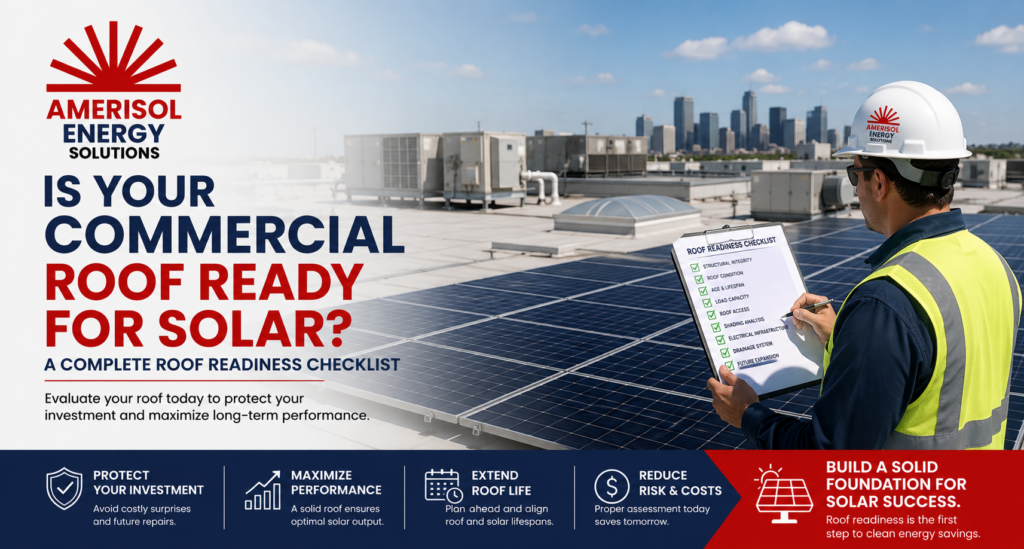
Installing a commercial roof solar energy system is one of the most effective ways businesses can reduce electricity costs, improve sustainability, and protect against rising utility rates. However, one critical question is often overlooked during the early planning stages:
Is your commercial roof actually ready for solar?
A successful commercial solar project starts long before the first solar module is installed. The condition, age, structural capacity, and design of your roof all play a major role in determining project costs, installation timelines, and long-term system performance.
Whether you’re planning a new installation or evaluating an existing building, this guide outlines the key factors to assess before moving forward with a commercial rooftop solar project.
Why Roof Readiness Matters
Commercial solar systems are designed to operate for 25 to 35 years. If the roof beneath the system requires major repairs or replacement during that time, removing and reinstalling the solar array can become a significant and avoidable expense.
Evaluating roof readiness early helps:
- Avoid unexpected construction costs
- Reduce project delays
- Improve long-term system reliability
- Extend the life of both the roof and the solar installation
- Maximize return on investment (ROI)
1. Evaluate the Age of the Roof
One of the first questions any developer or EPC contractor should ask is:
How old is the roof?
If the roof is approaching the end of its service life, replacing it before installing solar is often the most economical decision.
Typical commercial roof lifespans include:
| Roofing Material | Typical Lifespan |
|---|---|
| TPO | 20–30 years |
| EPDM | 20–30 years |
| PVC | 20–30 years |
| Modified Bitumen | 20–25 years |
| Built-Up Roof (BUR) | 20–30 years |
| Metal Roof | 40–60 years |
A roof with only a few years of remaining life may cost far more to replace after solar is installed than before.
2. Verify Structural Capacity
Solar panels, racking, ballast, and maintenance personnel all add weight to the roof.
A structural engineer should verify that the building can safely support:
- Solar modules
- Mounting systems
- Ballasted equipment
- Snow loads
- Wind loads
- Maintenance access
- Future equipment additions
In some cases, structural reinforcement may be recommended before installation.
3. Inspect the Roof Condition
Even relatively new roofs should undergo a detailed inspection before installation.
Look for signs of:
- Water intrusion
- Ponding water
- Damaged membrane
- Loose flashing
- Cracks
- Soft insulation
- Rust (metal roofs)
- Previous repair areas
- Drainage issues
Addressing these issues beforehand reduces the likelihood of leaks and future service interruptions.
4. Identify Roof Obstructions
Every rooftop contains equipment that may affect system layout.
Common obstructions include:
- HVAC units
- Exhaust fans
- Skylights
- Roof hatches
- Plumbing vents
- Satellite equipment
- Communication antennas
- Safety rails
A professional site survey helps optimize panel placement while maintaining required access pathways and service clearances.
5. Evaluate Roof Orientation and Available Space
Not every square foot of roof space is usable for solar.
Designers evaluate:
- Roof dimensions
- Available unobstructed area
- Roof slope
- Orientation
- Shading
- Fire access pathways
- Equipment setbacks
A detailed layout determines the maximum system size that can be installed while complying with local building and fire codes.
6. Analyze Shading Throughout the Day
Nearby objects can significantly reduce solar production.
Potential shading sources include:
- Adjacent buildings
- Trees
- Rooftop equipment
- Utility poles
- Future construction
- Mechanical penthouses
Modern solar design software can model shading throughout the year to optimize system performance.
7. Review the Electrical Infrastructure
The roof may be ready—but is the building’s electrical system?
A commercial solar assessment should include:
- Main service capacity
- Switchgear condition
- Panelboards
- Transformer sizing
- Interconnection location
- Available breaker space
- Utility requirements
In some cases, electrical upgrades are needed before a solar system can be interconnected.
8. Plan for Future Roof Access
Solar arrays should not prevent maintenance personnel from accessing rooftop equipment.
Proper designs include:
- Maintenance walkways
- Service clearances
- Fire access paths
- Safe roof access
- Future HVAC replacement considerations
Planning for maintenance today helps avoid costly modifications later.
9. Consider Future Battery Storage
Many commercial customers eventually add Battery Energy Storage Systems (BESS).
Planning ahead allows developers to:
- Reserve electrical capacity
- Size inverters appropriately
- Design switchgear for expansion
- Simplify future battery integration
Even if batteries are not part of the initial installation, designing with expansion in mind can reduce future project costs.
10. Work With Experienced Solar Professionals
Commercial rooftop solar projects involve multiple disciplines, including:
- Structural engineering
- Roofing
- Electrical engineering
- Utility interconnection
- Procurement
- Construction
- Commissioning
Working with experienced EPC contractors, engineers, and equipment suppliers helps identify potential issues early and keeps projects on schedule.
Roof Readiness Checklist
Before installing commercial rooftop solar, confirm that your building has:
✔ A roof with sufficient remaining service life
✔ Adequate structural capacity
✔ No significant water damage or roof defects
✔ Minimal shading
✔ Sufficient usable roof area
✔ Proper electrical infrastructure
✔ Safe maintenance access
✔ Space for future expansion
✔ A completed professional structural and roofing assessment
How AmeriSol Energy Solutions Can Help
Successful commercial solar projects begin with the right equipment and procurement strategy.
AmeriSol Energy Solutions supports EPC contractors, developers, facility managers, and commercial building owners by supplying:
We can assist with:
- Solar modules
- Commercial inverters
- Battery Energy Storage Systems (BESS)
- EV charging infrastructure
- Balance-of-system equipment
- Procurement support for large commercial projects
Whether you’re evaluating a new rooftop solar installation or planning a large commercial project, our team can help you identify equipment that aligns with your technical requirements, budget, and project schedule.
For equipment pricing and availability, please complete our Request Pricing & Availability Form.
For project consultation and equipment sourcing assistance, please complete our Free Consultation Form.
For immediate assistance:
Website: https://american-solar.com
Phone: (929) 376-0807
Email: contact@american-solar.com
Final Thoughts
A commercial rooftop may appear suitable for solar at first glance, but a comprehensive roof readiness assessment can reveal structural, roofing, electrical, and operational considerations that significantly impact project success.
By evaluating roof condition, structural capacity, electrical infrastructure, and future expansion needs before installation, building owners can reduce project risks, avoid costly surprises, and maximize the long-term value of their solar investment.
Investing in roof readiness today helps ensure that your commercial solar system performs reliably for decades to come.
References
- U.S. Department of Energy – Solar Energy Technologies Office
https://www.energy.gov/eere/solar/solar-energy-technologies-office - National Renewable Energy Laboratory (NREL) – Commercial Building Solar Resources
https://www.nrel.gov/buildings/ - Solar Energy Industries Association (SEIA) – Commercial Solar
https://www.seia.org - National Fire Protection Association (NFPA 1 Fire Code – Rooftop Solar Access Requirements)
https://www.nfpa.org - International Code Council (ICC) – International Building Code (IBC)
https://www.iccsafe.org