Commercial Solar Repowering Case Study: Is It Time to Upgrade a 250 kW Warehouse Solar System Installed in 2012?
Executive Summary
As thousands of commercial solar systems installed during the early 2010s approach 15 years of operation, facility owners are facing a critical question:
Should they continue maintaining aging equipment, or invest in a complete solar repowering project?
This case study evaluates a hypothetical 250 kW rooftop solar system installed on a warehouse facility in 2012 and compares the financial and operational impact of maintaining the existing system versus repowering with modern solar technology.
Project Overview
Facility Type: Commercial Warehouse
Location: New Jersey
Original System Size: 250 kW DC
Commissioning Year: 2012
Roof Type: Flat Membrane Roof
Original Modules: 250W Polycrystalline
Original Inverters: Central Inverters
System Age: 14 Years
Over time, the facility owner has experienced:
- Reduced annual energy production
- Multiple inverter service calls
- Difficulty sourcing replacement components
- Increasing maintenance costs
- Growing electricity rates
The owner is evaluating whether to continue repairing the system or perform a full repowering upgrade.
Existing System Performance
When originally commissioned, the system generated approximately:
325,000 kWh per year
After 14 years of degradation and equipment aging, annual production has fallen to approximately:
275,000 kWh per year
This represents a reduction of nearly 15% in annual energy production.
Additional concerns include:
- Increased inverter downtime
- Obsolete equipment
- Reduced monitoring capabilities
- Limited warranty coverage
Repowering Solution
The proposed repowering strategy includes:
New High-Efficiency Modules
Replace aging 250W modules with modern 600W+ bifacial modules where roof loading and layout permit.
Modern String Inverters
Replace aging central inverters with modern string inverter technology featuring:
- Advanced monitoring
- Higher efficiency
- Improved reliability
- Faster troubleshooting
Updated Monitoring Platform
Implement real-time system monitoring and performance analytics.
Electrical Upgrades
Replace aging disconnects, combiners, and associated balance-of-system components as required.
Expected Performance Improvements
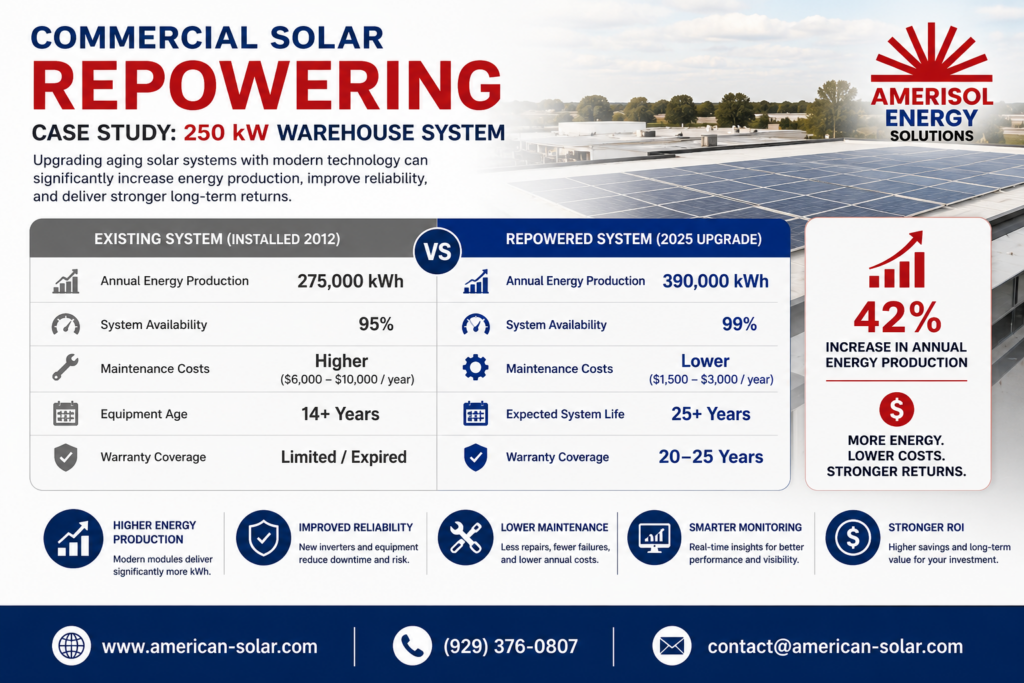
Existing System
- Annual Production: 275,000 kWh
- System Availability: 95%
- Estimated Remaining Life: 5-7 Years
Repowered System
- Annual Production: 390,000 kWh
- System Availability: 99%
- Expected Service Life: 25+ Years
Production Increase
The repowered system is projected to generate:
115,000 additional kWh annually
This represents approximately:
42% more energy production
compared to the aging system.
Financial Analysis
Assumptions
- Utility Rate: $0.16/kWh
- Utility Escalation: 3% annually
- Analysis Period: 10 Years
Existing System Value
Annual Energy Savings:
$44,000
Repowered System Value
Annual Energy Savings:
$62,400
Additional Annual Savings
$18,400
before accounting for maintenance savings and reduced downtime.
Maintenance Cost Comparison
Existing System
Average Annual Maintenance:
$6,000-$10,000
Potential major inverter replacement costs remain a significant risk.
Repowered System
Average Annual Maintenance:
$1,500-$3,000
supported by modern equipment warranties and improved monitoring.
Operational Benefits Beyond Energy Production
Many facility owners focus exclusively on energy output, but repowering delivers additional benefits:
Improved Reliability
Modern equipment significantly reduces unexpected downtime.
Better Monitoring
Real-time monitoring helps identify issues before they impact production.
Easier Parts Availability
Current-generation equipment is supported by active manufacturer supply chains.
Enhanced Safety
Electrical upgrades help bring older installations closer to current industry standards.
Increased Property Value
Modernized energy infrastructure can improve long-term facility value and marketability.
Is Repowering Worth It?
For many commercial solar systems installed between 2010 and 2015, the answer is increasingly yes.
When systems begin experiencing:
- Frequent inverter failures
- Significant production decline
- Expiring warranties
- Difficulty sourcing replacement parts
a strategic repowering project can often provide a stronger long-term return than continuing to repair aging equipment.
Every facility is unique, and a detailed engineering assessment should be performed before making investment decisions.
How AmeriSol Energy Solutions Can Help
AmeriSol Energy Solutions supports commercial and industrial clients with:
- Solar repowering evaluations
- Equipment procurement
- High-efficiency solar modules
- Inverter replacement solutions
- Energy storage integration
- Logistics and project support
Whether your facility operates a 100 kW rooftop system or a multi-megawatt solar asset, our team can help evaluate upgrade opportunities and identify the most cost-effective path forward.
Get a Free Consultation | Residential, Commercial & Industrial
Disclaimer: This case study is a hypothetical example intended for educational purposes only. Actual project economics, energy production, utility rates, equipment costs, and financial results will vary based on site-specific conditions, engineering design, local regulations, and market pricing.
References:
NREL – Quantifying the Impact of PV System Repowering and Module Reuse on PV Project Economics, Sustainability & Equity
https://docs.nrel.gov/docs/fy25osti/91745.pdfU.S. Department of Energy – End-of-Life Management for Solar Photovoltaics
https://www.energy.gov/cmei/systems/end-life-management-solar-photovoltaicsNREL – Photovoltaic Degradation Rates: An Analytical Review
https://docs.nrel.gov/docs/fy12osti/51664.pdfNREL – Best Practices at the End of the Photovoltaic System Performance Period
https://docs.nrel.gov/docs/fy21osti/78678.pdfIEA PVPS – Assessment of Performance Loss Rate of PV Power Systems
https://iea-pvps.org/wp-content/uploads/2021/04/IEA-PVPS-T13-22_2021-Assessment-of-Performance-Loss-Rate-of-PV-Power-Systems-report.pdf